
Think Pieces
On people, power, relationships, and radical possibilities.
Prefer listening? This AI-generated audio conversation below explores The Ghost Stand-In, unpacking its stories, Black Feminist analysis, and invitations to practice allyship. The discussion offers interpretations of the essay, not a word-for-word reading. Unfortunately, I can’t control the white American sounding voices of the two speakers nor what they say - I can only instruct it on what to consider about the essay. Sorry.
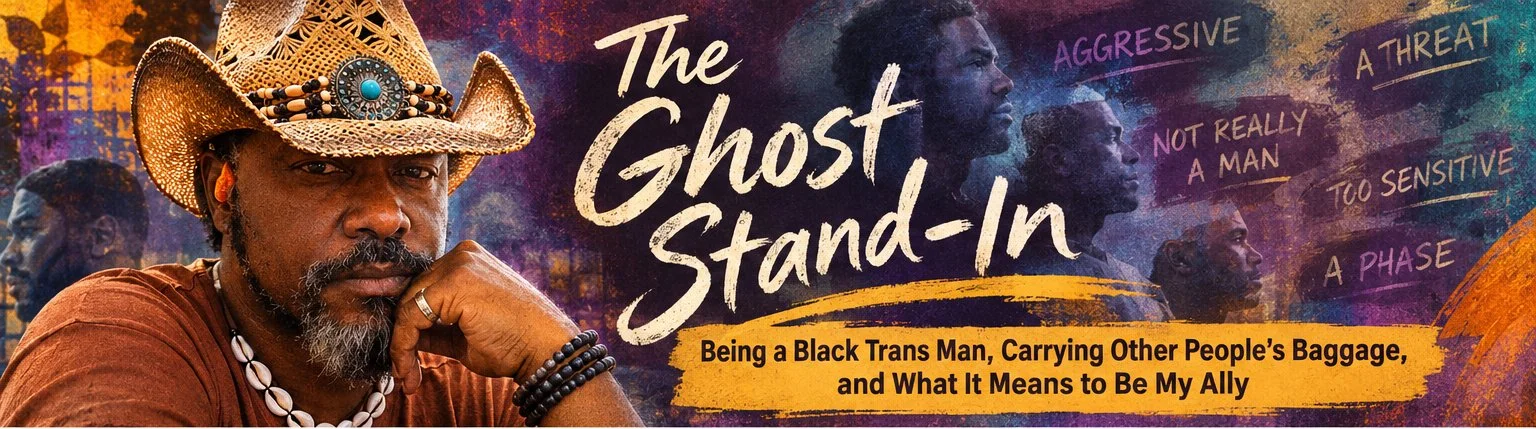
The Ghost Stand-In
by Joe Jackson - November 11th, 2026
10–15 minute read
Two Experiences
One evening in New Orleans, I was sitting outside a place called the Friendly Bar, talking on the phone to a woman I was super in love with. I was sprung. I kept thinking I would go inside and get myself a drink, but I was so wrapped up in wanting to hear her voice that I just kept talking. Suddenly, I became aware of a White cisgender man standing over me, his face red, yelling that I needed to leave immediately. It took me a moment to come out of my cloud and figure out what the hell was happening and that he was the door-person that beautiful sunny day. When I asked why, he angrily explained that I'd been sitting there for 45 minutes without buying anything. Okay. I told my girl I'd call her back, went inside, bought a drink, and tipped the bartender $50. That tip was deliberate. I knew the bartender would likely tell the man, creating some social pressure to leave me alone while challenging whatever assumptions he had made about me. That $50 gave me a way to challenge his perception of me without saying a word. But there would come a time after this incident when I wouldn't have had $50 to spend correcting somebody else's ghost. Dealing with racism is costly. Anyway, on my way out, I approached him and offered a little feedback: he could have simply invited me to buy something and, if I declined, politely let me know they would love me to return when I was able to do so. There was no need for hostility. He doubled down, insisting that everybody knows you're supposed to buy something. Now, I gotta say this - most of the bars in the neighborhood, including this place has people who come and sit outside without buying anything, and no one bothers them unless they are bothering people. Also, I had been a customer there before, including when this very man was bartending. But even if I hadn't, what required him to come at me at a hundred? I ended up sitting outside for another five hours without buying another damn drink, daring him to come at me again. He didn't. All of this at a place called the Friendly Bar.
In another experience, I was heading into winter break after having just been laid off from my full-time position and shifted into part-time work without benefits. I was the one person on our team entering the holidays in a dramatically different financial situation. I wouldn't be buying gifts for anyone, including the children in my family. I couldn't afford to travel from this city where I had no roots to be with family and friends. I would spend the holidays and my birthday alone. Going into our last team meeting of the year, I assumed we’d spend some time reflecting on the year together, and there would be a little love, care, or even some commiseration about what I was facing. Instead, my White cisgender woman supervisor went full frontal off on me. Out of nowhere, she began listing her accomplishments and qualifications, becoming increasingly animated as she spoke. Her face turned red, her brow tightened, and her voice grew louder with each listed item until she ended by yelling her title at me. I was stunned. I hadn't questioned her competence or experience. It hadn't even occurred to me in this meeting or at any point over the previous years to do so. I hadn't said or done anything that would explain why she got on that topic or why she was addressing me with such hostility. I froze. Afterward, I asked another colleague who witnessed it what that was about. She couldn't connect it to anything I'd said or done. To this day, I can't figure it out. But I know what it did to me. It shook my nervous system, grated against my dignity, and left me with a quiet sadness. I mean the supervisor knew the situation I was in, given that she was the one who had to decide and deliver the lay-offs. At a moment when I could have used some tenderness and compassion, especially from these people I cared about and felt loyal to, I received hostility over something I hadn't said, done, or even thought.
She would occasionally do versions of this at a much lower decibel over the next couple of years I worked with her. Out of nowhere, she'd say things like, “I don’t know what you know about me, Joe, but I can…” and then list her capabilities. Just like that winter blow-up, I couldn't connect these statements to anything I'd said or done. Each time, I froze, confused about what she was responding to. And I never addressed these moments with her. Some of my own past trauma shows up as anxiety about how people might respond when I give them feedback. I do speak up sometimes, but most times I have to push past a whole lot of mental stress to get there. And I couldn't push past it on this matter.
She was talking to a ghost. I was just the stand-in.
The Ghost Stand-In
I call these “ghost stand-in” experiences.
It's when someone interacts with me in ways that are completely outside the context of Joe—who I am, what I've actually said or done, and what is happening between us. It's as though they're interacting with somebody else, except I'm the person standing there receiving it.
That ghost could be a Black man from their past, someone they had a difficult experience with, or their own internal anxieties. It could also be an imagined Black man constructed from cultural stereotypes and controlling images of who Black men are supposed to be, how we behave, and what people should expect from us. The ghost could be one or any combination of these three things.
I don't know what ghosts those two people were interacting with. I just know neither of them was responding to the person actually standing there. That is erasure. And when someone has power over me, their imagined version of who I am can carry more authority than my own account of myself. That's where misrecognition can become epistemic oppression—even epistemic violence. A necessary practice of liberation, then, is to recognize and respect my authority to define myself, my thoughts, my feelings, and my experience, rather than allowing somebody else's ghost to do it for me.
Before transitioning into Black manhood, back when I was passing as a butch Black dyke, I occasionally encountered this sort of thing, perhaps a couple of times a year - though that social location certainly has a version of this issue too, but different. But around age thirty, I began taking testosterone. My voice deepened, I grew facial hair, and people increasingly understood me as a Black man. The ghost stand-in experience became a daily occurrence.
The biggest change was people's comfort expressing hostility toward me and withholding of emotional sensitivity.
And it's not limited to strangers. It happens with colleagues, associates, people in my social circles, and, more rarely, people I feel close to. And to some folks' credit, there have been times when people I regularly interact with have recognized their mistake and said so. Some have even commented on how chill I am about it, because I try to offer grace and make room for repair when I realize I've been standing in for somebody else's ghost.
Most of these daily experiences are subtle. They don't all involve yelling or lead to consequential harm. Sometimes I just notice that someone is interacting with me in a way that has absolutely nothing to do with who I am - even if pleasant.
Once, I was chilling at a bar talking to a guy I saw there frequently. He was a Black New Orleans man who made jokes into a whole long story, usually about his experiences with women. On this particular day, two dudes sat at the table next to us and struck up a conversation with him. I heard one refer to the other as his husband.
So I said, "Oh, did you say he's your husband?"
The guy I was hanging with stood up and said, "Hold on, uh-uh, hold on, man..."
I ignored him, introduced myself to the two guys, and said, "I envy gay men's marriages—so much freedom for many of you. My love of Black women won’t likely ever offer that kind of freedom. I ain’t been with a Black woman yet that would be down for polyamory. Let me guess, you both have other boyfriends?" Now to be sure, not all gay men’s marriages are open - but these two gave the flavor of having that arrangement, so I felt comfortable saying it and offering a moment of humor. And through our laughs, I would learn that I hit the nail on the head with them - their boyfriend was in the bar getting their drinks.
And just like that, the guy I was hanging with got a big smile on his face. His whole demeanor changed. From his reaction, I understood that he'd been worried I was about to be hateful toward the gay couple. Apparently, it hadn't occurred to him that I might have no problem with them at all.
He was even happier when I told him I'm a transgender man. He seemed relieved. Turned out he was bisexual and had a transgender girlfriend. It became clear that I was a ghost stand in for his understanding of Black men in New Orleans up until this day.
So it's not always bad. It's just that every day, I'm navigating the distance between who people assume I am and who I actually am.
I suspect many Black men will recognize versions of this experience. But Black cisgender men have probably experienced this their whole life, so it’s the water they swim in - perhaps unnoticeable until something outrageous happens. But for me, I had thirty years of less of it - so I notice it, everyday.
There's another layer of invisibility, too. Most people assume I'm a cisgender man unless I tell them otherwise. The imagined Black man they're interacting with often doesn't even include the possibility that I might be a transgender man.
What It Costs Me
The most persistent impact is invisibility.
I'm present, but somebody is interacting with a person who isn't me. And now I'm dealing with their baggage. I'm trying to figure out what they think is happening, whether I can correct it, and whether doing so might make things worse.
Sometimes I speak up. Sometimes I decide it's not worth my energy. And sometimes my trauma responses kick-in, as happened with my supervisor, I freeze or fawn or some combination of them both. I can't find the words in the moment, and afterward I spend time trying to understand what the hell just happened. Fawning could look like a smile and a joke at my own expense to bring the temperature down, or unconsciously pulling my shoulders in and lowering my head to make my body as small as I can when walking past a stranger who expresses clear signs of worry or fear the closer I get to them. Sometimes I “fight” (not necessarily physically - mostly I argue), but mostly when I am backed in a corner, facing a threat of harm, and my nervous system I suppose sees no other way out of the danger.
I've also experienced something related but different since transitioning: the automatic withholding of what had once been fairly ordinary emotional sensitivity toward me. People seem much more comfortable being flippant, dismissive, or outright mean, as though Black men can and should take everything without experiencing emotional or psychological pain. I've found myself offering tenderness, reassurance, and affirmation to people who rarely seemed to consider that I might need those same things. I don't necessarily count that as a ghost stand-in experience, but I do wonder what assumptions about Black manhood make my need for care so easy to overlook.
And these experiences aren't just emotionally exhausting. They require me to continuously calculate how to navigate other people's perceptions.
And what happens when the person’s ghost has power over my livelihood, opportunities, reputation, or safety?
The consequences can go far beyond an unpleasant interaction. Someone's unexamined perceptions can lead to exclusion, economic harm, or even state violence—all justified as reasonable responses to threats that never existed. Think about how Whiteness works: a White person fears a Black man, and other White folks recognize that fear as reasonable because they've felt it themselves. Nobody has to mention race. When Whiteness is treated as the default, its fears become the measure of what's reasonable. And that's how a police officer's perception of a threat can justify violence, while a workplace's perception of legal “risk” can justify taking away an employee’s livelihood in a manner that demonstrates no honor of that person’s dignity and humanity. In both cases, institutions can legitimize harm without ever establishing that the person posed a threat, they only need to be convincing that they perceived a threat or a risk to deny a person dignity, economic opportunity, and even life.
The ghost doesn't have to be real for the harm to be.
Using Black Feminist Thought to Be My Ally
The thing is, I've spent years navigating these experiences, trying to figure out what other people are responding to and how to manage it.
But why should the responsibility for dealing with somebody else's ghost fall entirely on me?
What would it look like for my allies to take responsibility for their own perceptions, and to use their power to interrupt the harm those perceptions can cause?
For Transgender Awareness Week, I want to offer some possibilities.
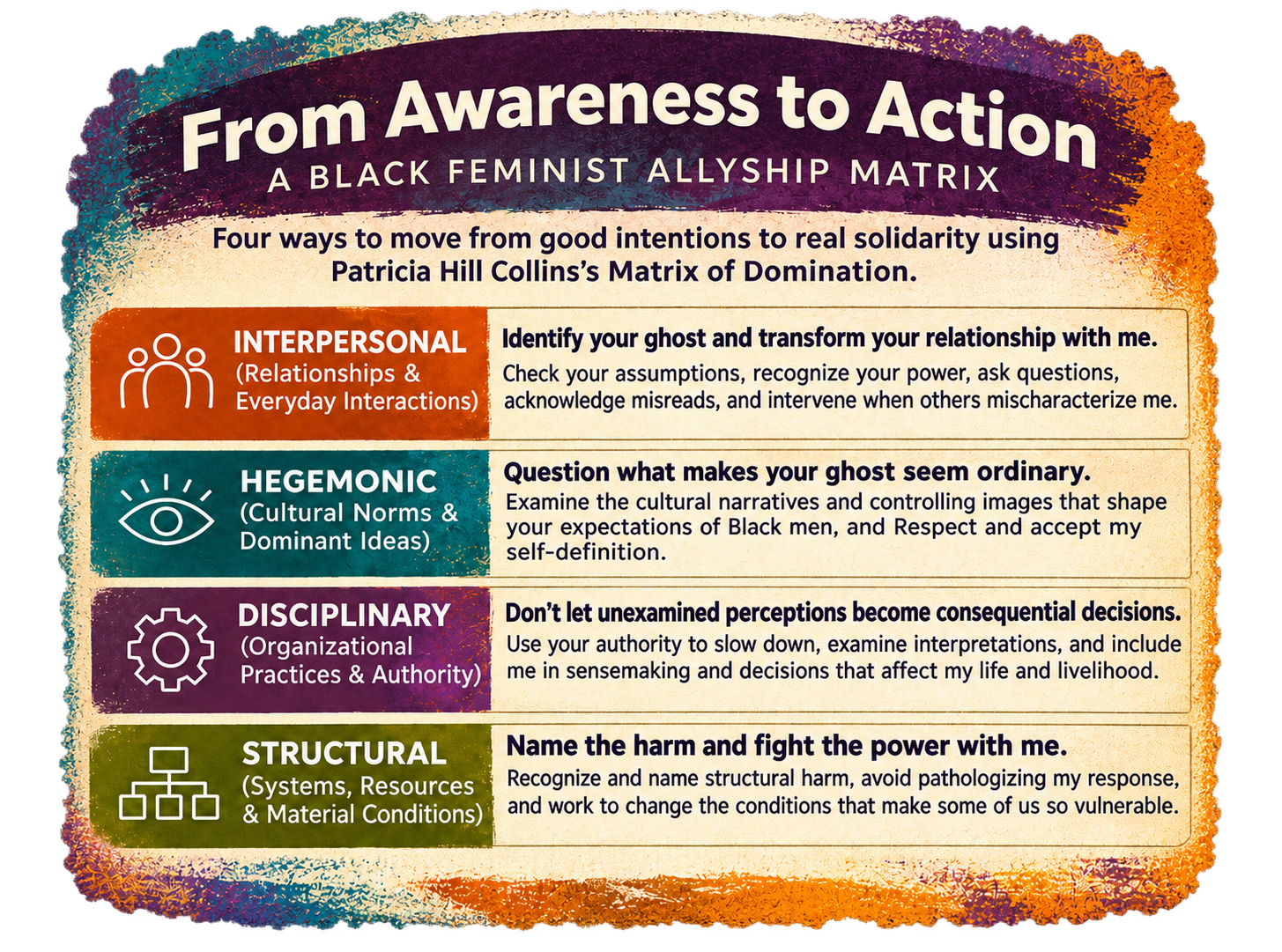
Black Feminist scholar Patricia Hill Collins's Matrix of Domination provides a useful framework for examining how oppression operates through four interconnected domains of power: interpersonal, hegemonic, disciplinary, and structural.
Here's how I would invite you to use that framework to practice allyship with me.
1. Interpersonal Domain: Identify your ghost and transform your relationship with me.
Practice critical self-reflection. When you find yourself reacting to me, ask whether that reaction is grounded in something I actually said or did. What assumptions are you bringing into the encounter? What ghost might you be interacting with? If I tell you I have concern that your actions or words are compromising of my positionality relative to yours, engage in genuine deep critical self-reflection toward a sincere effort to identify even just the possibility of it. It doesn’t mean that after such an effort you will agree, but your inquiry should result in understanding.
Recognize your social privilege and power relative to me, and take responsibility for how you exercise it.
Then transform how you relate to me. Ask questions rather than assign intentions. Be willing to acknowledge when you've misread me.
And practice everyday acts of solidarity. If you have the power and privilege when you witness someone mischaracterizing me, you might say, "I didn't hear Joe question your qualifications. What made you think he was?" If you don’t have that power and privilege in a moment like that, then you might simply share commiseration like, “I didn’t hear you question her qualifications. I didn’t even hear anything related to that topic at all before she did that.”
Use your relative power and privilege to bring me from the margin to the center with you, rather than leaving me alone to challenge someone else's perception.
2. Hegemonic Domain: Question what makes your ghost seem ordinary.
We all have ghosts. And when we are allies doing critical self-reflection, that can include trying to understand what is the water we’re swimming in - what about the culture normalizes my ghost as reasonable and assumed? We can ask ourselves:
"What made how I perceived and spoke to him ordinary to me? What made my thoughts about him common sense to me? Is there a correlation between my thoughts about him and social expectations of a Black man?"
What have you learned about Black masculinity? What assumptions do you carry about aggression, hyper-sexuality, danger, emotional vulnerability, psychological stability, competence, or authority?
Think about the cultural narratives, media representations, and controlling images that have taught you what to expect from Black men. This can also be questions we ask in our localized cultures - like our social groups, workplaces, and political groups. Question those ideas, particularly when they feel like common sense. This is what is called developing critical consciousness.
Accept and amplify my self-definition. Allow me to tell you who I am, what I think, and what I believe. When the person I tell you I am conflicts with the person you've imagined, let go of that imagination.
3. Disciplinary Domain: Don't let unexamined perceptions become consequential decisions.
If you hold organizational authority, use it to create practices, tools, processes, and structures that require critical self-reflection and collective examination of perceptions, particularly when those perceptions may influence someone's livelihood or well-being.
Imagine someone describes a Black male colleague as aggressive, hostile, or difficult to work with. Before accepting that characterization, ask: "What specifically did he say or do? What makes us interpret that behavior that way? Would we respond similarly if someone else had done the same thing?"
Examine perceptions rather than automatically privileging the account of the person with the most institutional authority.
And bring me from the margin to the center of decisions that will significantly affect my life. Include me in the sensemaking and decision-making while I still have an opportunity to influence the outcome—not simply when it's time to tell me what you've decided. Include my own knowledge of myself in the record, not just the ghosts of those with power.
4. Structural Domain: Name the harm, and fight the power with me.
Identify and name structural harms when they occur.
When I respond to economic insecurity, exclusion, threats to my livelihood, or other forms of structural violence, don't pathologize my response as an individual deficit. If I am sad because I am facing financial stress - don’t tell me to pray and take more walks. Name the “organizational economic violence and racial capitalism” that caused the harm. If I enter financial terror once my savings runs out from subsidizing my loss in income - don’t tell me “you need to save.” Name the “organizational economic violence and racial capitalism” that caused this harm and let’s organize ourselves to pursue radically creative ways to combat that structural force.
Recognize my distress, fear, anger, depression, and resistance as understandable, ordinary, and reasonable human responses to harmful conditions.
And then look beyond my response to the structures creating those conditions. Question how authority, material resources, protections, and opportunities are distributed. Work with me to change the arrangements that make some people so vulnerable to the unchecked power of others.
That's what it means to move beyond helping me survive oppression toward building conditions in which we can all live differently. We don’t tell me something is wrong with me when I start coughing from the smoke coming from the building being on fire. We don’t toss me a cough drop and tell me what breathing exercises I need to do to improve my coughing problem. We don’t look down on me when I say, “Fuck that cough drop. We need to organize to put out the fire!”
Note: Identifying and naming structural harm, and avoiding pathologizing people for their human responses to that harm is a critical component to abolition Black Feminism, particular those Black Feminists in the healing, restorative, and transformative justice spaces and those down with liberation, decolonial, and critical psychology lineages.
Beyond Allyship
I want to be able to sit outside with my dog and be in love. I want to do my work, disagree, make mistakes, be vulnerable, and have ordinary human relationships without constantly managing somebody else's imagined version of me.
I should not have to establish that I am a person worth treating with tenderness before we can have an ordinary conversation.
I love when y'all step in when you see someone treating me with racism or transphobia. But what I need most is for you to step in on yourselves. Question how my Black trans manness shapes what you think I mean, feel, understand, or intend.
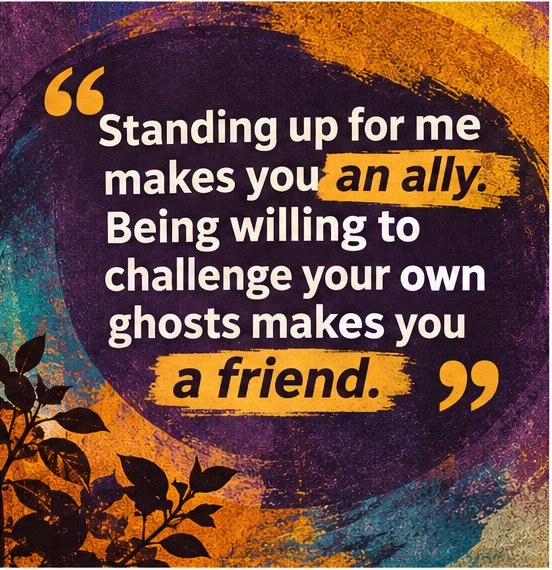
Standing up for me in the world makes you an ally. Standing up for me against your ghosts makes you a friend. And I am every bit as much a friend back.