
Shifting power concept and practice
Definition: Shifting power is the intentional practice of redistributing voice, authority, resources, decision-making, safety, and love toward people and communities on the margins who are most negatively impacted by decisions, systems, and structures we have been excluded from shaping.
In organizational practice: Shifting power extends beyond input and listening. It means bringing people who are closest to the impact, but often farthest from formal authority, into the decision-making that shapes their work, well-being, and lives. It also means asking whether people have the information, resources, material security, and actual authority needed for their participation to matter.
“Marginality is much more than a site of deprivation… it is also the site of radical possibility, a space of resistance.”
— bell hooks, Choosing the Margin as a Space of Radical Openness
Our Approach
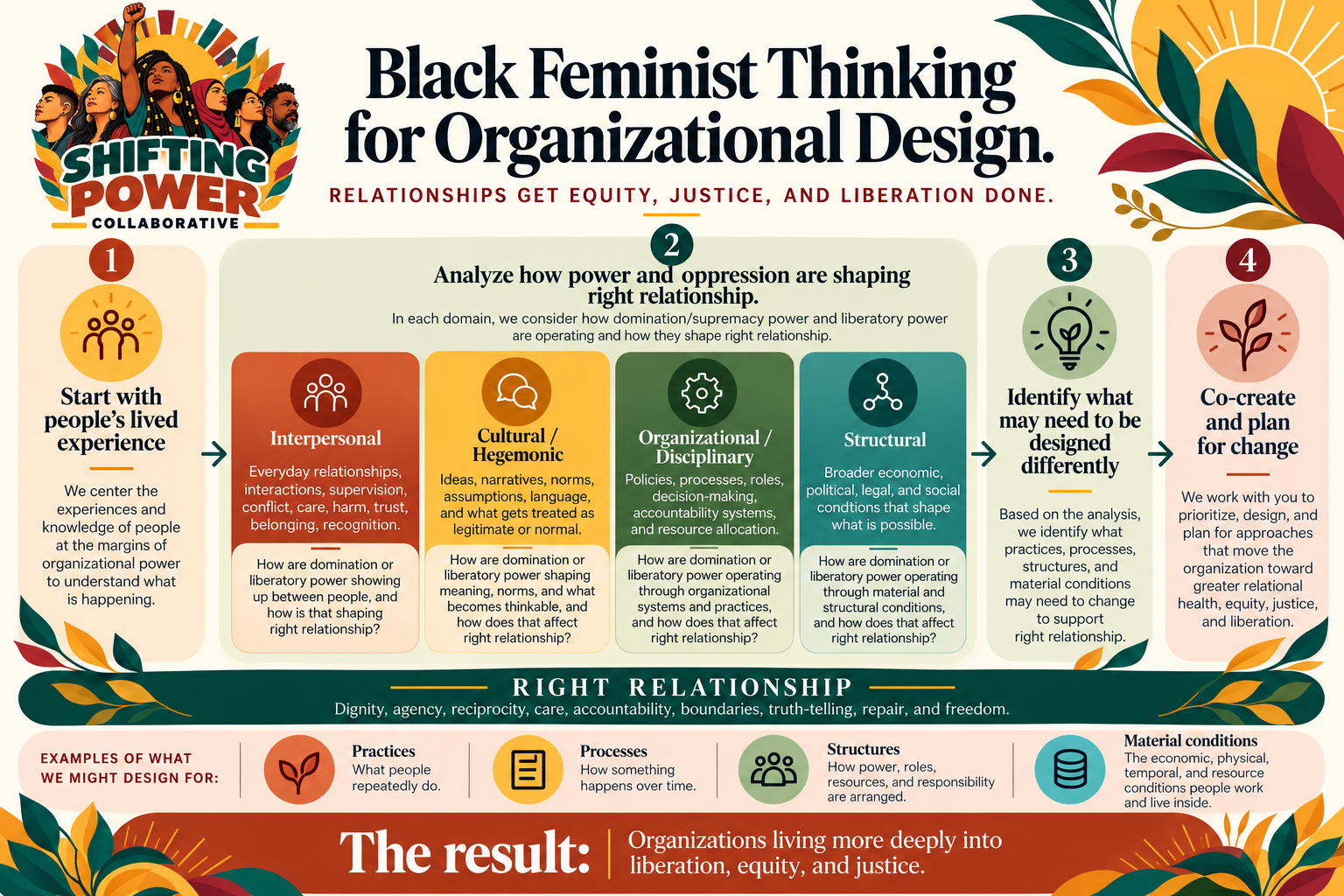
Our work translates Black Feminist thought into organizational analysis, design, and everyday practice. Our work begins with lived experience, especially the knowledge carried by people on the margins of organizational power. We understand lived experience as an important site of knowledge among many. We place that knowledge in conversation with Black Feminist thought and other bodies of knowledge that help us understand what people are experiencing and what may be producing it.
From there, we look at how power moves through everyday relationships, organizational culture and narratives, rules and practices, formal authority, structures, resources, and material conditions.
Then we ask:
What structural forces are producing this experience?
What forms of domination or exclusion may be operating?
What forms of resistance, self-definition, care, accountability, or collective power are already present?
What would right relationship require?
Theory of Change
Relationships get liberation, equity, and justice done.
We believe relationships are one of the places where people get lived experience practicing trust, shared power, conflict, accountability, boundaries, care, repair, decision-making, truth-telling, and freedom.
Our aim is right relationship… with individual self, with others, and with nature.
Right relationship does not mean permanent harmony, politeness, agreement, or keeping every relationship intact. Conflict will happen. Harm may happen. Relationships may need boundaries, distance, changed roles, repair, or supported endings. Right relationship means building conditions where dignity, agency, accountability, care, truth-telling, boundaries, repair, and freedom can remain possible even when people disagree or power is unequal.
Organizations can become practice sites for experimenting with these ways of being together.Over time, what people practice in relationships can become what teams expect, what organizations structure, what movements carry, and what society begins to normalize.
That is part of how we live into the future we are working toward while still building it.
What Grounds Our Practice
Our practice is rooted in liberation traditions.
Black Feminist thought is the intellectual and political center of our practice. It shapes how we understand power, knowledge, relationships, identity, domination, resistance, care, accountability, self-definition, collective action, and freedom.
Black Feminist thought also asks us to pay attention to where people are positioned within systems of power and what becomes visible when knowledge from the margins moves toward the center. So, we honor the knowledge carried by people and communities most impacted by histories of marginalization. That wisdom is not supplemental to the work. It is essential to liberation.
Our practice is especially shaped by Black Feminist approaches to lived experience as knowledge, margin-to-center analysis, self-definition and self-valuation, intersectional power, dialogue, an ethic of care, personal accountability, collective resistance, and the ways domination operates across interpersonal, cultural, organizational, and structural life.
Other liberation traditions deepen and extend that inquiry. Black Trans Feminism helps us think about gender, embodiment, self-definition, carceral abolitionist commitment, and freedom beyond dominant categories. Black Marxism and racial capitalism help us examine how identities in the space of marginality, labor, resources, extraction, and economic power shape organizational life.
Healing justice, liberation psychology, trauma psychology, nervous-system and stress science, and disability justice help us understand how organizational conditions are experienced in bodies and relationships without reducing structural problems to individual pathology. Restorative justice, transformative justice, Black Feminist abolition, Black Feminist legal studies, and community accountability deepen our thinking about conflict, accountability, repair, protection, and what becomes possible beyond punishment and disposability.
We also draw from critical race theory, epistemic oppression and justice theory, popular education, psychological safety, organizational development, and other traditions when they help us ask better questions or design more useful practice.
We do not use these traditions as a checklist. We draw from them where they help us understand what is happening and what liberation might require in practice. These frameworks shape how we listen, facilitate, design, analyze, learn, teach, hold conflict, notice hurt and harm, and support organizations in practicing their values under pressure.
We are fiercely committed to Black and Brown Trans leadership.
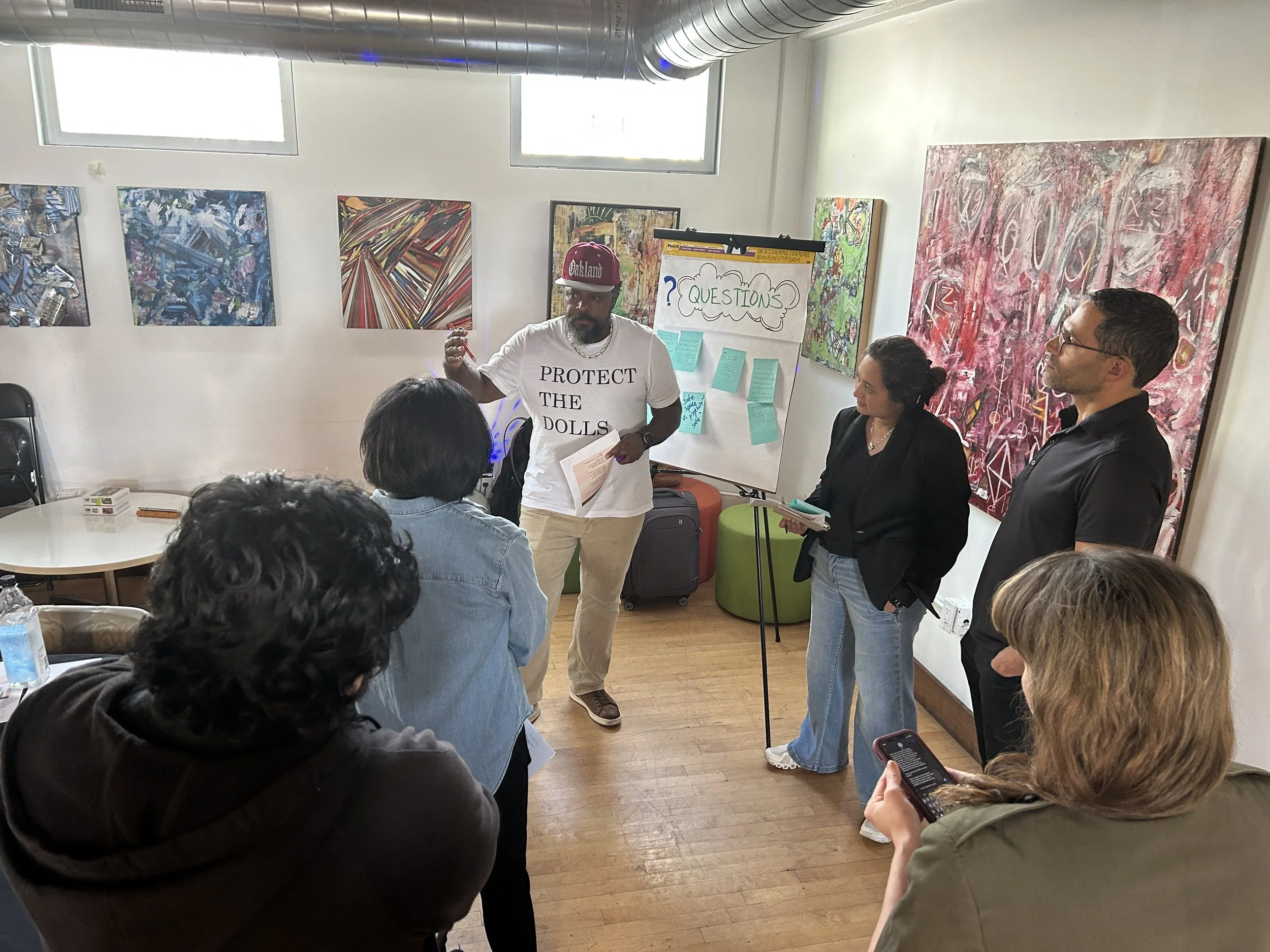
Shifting Power Collaborative is grounded in a fierce and loving commitment to the leadership, wisdom, safety, creativity, and liberation of Black and Brown transgender people.
Black and Brown Trans people are not only people organizations should include. We are leaders, strategists, facilitators, organizers, designers, theorists, culture-builders, and producers of knowledge. Our experiences at the intersections of race, gender, class, disability, institutional power, and social exclusion can reveal things about organizations that may be difficult to see from positions closer to dominant power. Because what people experience from the margins can hold critical knowledge about how power in organizations actually work and impact those without organizational power.
We believe organizations are stronger when the people most affected by their decisions have meaningful opportunities to shape the practices, structures, and conditions that govern their lives. This commitment shapes how we understand power, whose wisdom is trusted, whose pain is believed, whose leadership is resourced, and whose flourishing becomes part of the measure of organizational integrity.
What Collaboration Means Here
Many people call this consulting. We call ourselves collaborators.
We use the word collaborator because this work is not something we do to an organization. It is something we build with the people inside of it.
We bring facilitation, mediation, strategy, training, assessment, process design, and a practiced eye for how power is moving. Organizations bring the truth of their own context: the history, relationships, constraints, wisdom, tensions, hopes, and daily realities that no outside person can fully know.
Collaboration means we do not arrive with a pre-written answer and ask people to fit inside it. We listen, design, adjust, and make meaning with the people doing the work. We bring structure and skill to the process, but the path forward has to be shaped with the people who will live with it after we leave.
Commitments That Lead Our Work
Shifting and Sharing Power
We help organizations move power closer to the people most impacted by the decisions being made. That means going beyond input and creating clearer, more honest ways for people to shape decisions, resources, priorities, and practices.
Equity and Justice
We support organizations in examining how identity, structure, culture, history, and power shape people’s experience of the work. Equity and justice become real when we are practiced in decisions, relationships, policies, supervision, conflict, and repair.
Getting Free
We believe liberation is not only a future destination. It is something people can practice now in how we relate, tell the truth, share power, make choices, repair harm, and build conditions for dignity and self-determination.
Transparency
We value clarity because confusion often protects power at the expense of those without it. We help organizations be more honest about roles, authority, decision-making, constraints, expectations, conflict, and change so people can participate with more trust and less guessing.
Conflict Is Natural
We understand conflict as a natural part of relationship, collaboration, change, and justice work. Conflict is not bad by itself, but how we move through conflict can create hurt, harm, avoidance, punishment, or deeper disconnection. Conflict can show us where values are rubbing against practice, where power is uneven, where needs are unmet, where trust has frayed, and where something is asking for attention. When held with skill, honesty, intention, and empathy, conflict can be a place that leads to learning, repair, stronger agreements, new possibilities, and shifting and sharing power.